
Being Human is the UK’s national festival of the humanities. Each year, it invites humanities researchers and staff from universities and research organisations to apply to take part in the festival by organising a public engagement event, activity or project.
The festival aims to:
- demonstrate the value and relevance of humanities research to society in the UK and globally
- encourage, support and create opportunities for researchers to engage with non-specialist audiences
- embed and join together public engagement activities in the humanities across the higher education (HE) sector
Being Human Festival 2026 will take place from 5 – 14 November with the theme Crossroads:
‘From the streets of protest to the meeting points of cultures, from moments when society pivots to the choices we face today about climate, democracy, and technological change, researchers are invited to explore spaces of convergence and divergence, where paths meet, decisions will be made, and history turns.’
ELIGIBILITY
Projects and initiatives funded by the festival should be planned, led and delivered by professional researchers at a Higher Education Institution or an AHRC-recognised independent research organisation. The definition of professional researchers includes university lecturers and researchers (any career stage), curators and research librarians.
The festival uses a broad definition of the humanities, which encompasses the subject areas traditionally associated with the study of the human world. This includes, for example, art history, archaeology, classics, cultural studies, history, film, languages, law, literature, musicology, philosophy, theatre studies, theology, etc. However, providing the event has a strong humanities research presence, interdisciplinary and multidisciplinary events are more than welcome. Projects with artists, practitioners, social scientists, natural scientists, or any other researchers are very welcome as long as they offer a good fit with the festival’s objectives.
Full eligibility criteria and specific requirements for Institutional and Festival Grants can be found in their respective guidance documents on the opportunity webpage.
VALUE
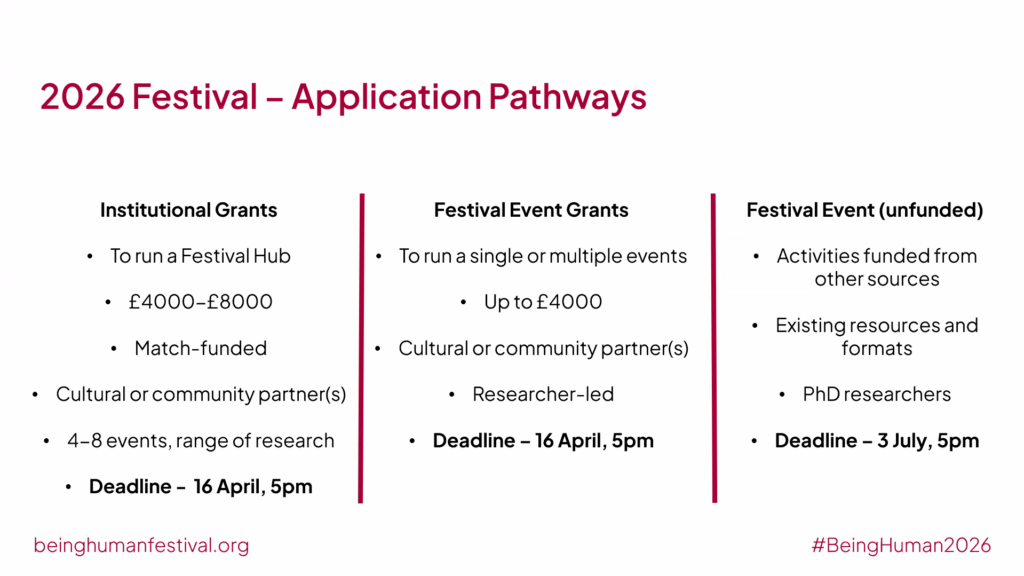
Two types of grants are available:
Institutional Grants of £4000-£8000 to coordinate and deliver a ‘Festival Hub’:
Intended to support the development of institutional capacity for public engagement activity in the humanities (e.g. to try something new or to work with new communities).
Festival Hubs must:
- be made up of 4-8 separate events or activities in a range of formats
- include one large-capacity or particularly ambitious headline event
- include one event led by a PhD researcher (with a letter of support from their supervisor)
- include at least one activity aimed at families or young people
- feature a range of humanities research from a range of disciplines, covering different topics and subject areas
Festival Grants of up to £4000 to run a single event or multiple events:
Designed to support ambitious, ‘best practice’ activities that would not run without financial support from the festival. Unlike Festival Hubs, these grants are for projects led by individual researchers. They can be used to fund projects culminating in either a single event or a small series of activities (if used to run a small series of events, you are encouraged to think about the events as a coherent series of related events, and to convey the relationship between the events in your application).
While there is no rule against organisations submitting multiple applications for funding, they are encouraged to apply for an Institutional Grant where there are opportunities to collaborate. With this in mind, please email researchoffice@worc.ac.uk to discuss your proposal in the first instance.
KEY DATES
Applicant webinar: 25 February 2026
Institutional Grant application deadline: 16 April 2026
Festival Grant application deadline: 16 April 2026
Festival dates within which the main activity should take place: 5-14 November 2026
Those considering applying should refer to the relevant information documents, case studies, planning toolkits and FAQs.
Free online training sessions are also available:
- Introduction to Creative Public Engagement (5 March 2026)
- Creative Engagement Workshop – Designing activities from your research (12 March 2026)
- Partnerships (26 March 2026)
- Introduction to Engagement and Inclusion (14 May 2026)
- Audiences and Planning (18 June 2026)
- Promoting Public Engagement Events (9 July 2026)
- Working with Press and Media (22 July 2026)
- Event Delivery and Top Tips (1 October 2026)